User guide
Quick Start Guide
Case notes
Table component
FAQ
Search
Dashboard
Deleted Documents and Access Log
Solving a task
AI Assistant
Manuals
Substitution and Vacation
Suspending, resuming, archiving and deleting a case
Case variables, history and graph
Basic Terms
Uploading Documents, Folders and Revisions
News
Favorites
Navigating the interface
Dashboard widgets
Case Detail
News/Announcements in Team assistant
Case list
Logging In and Out
Account Settings
Task List
Mobile app settings
Reports and Charts
Searching and Listing Documents
Handing Over, Taking Over and Tasks to Pull
Bulk Tasks
Printing a Case
Creating and Editing an Overview
What Is TAS
Form Fields
Tablet Interface and NFC
Overviews
Creating a New Case
Case Events
Case Permissions
Subscribing to an overview by email
Administrator Guide
Platform guide
Administration
Crons
Authentication and Synchronization
SMTP OAuth authentication
LDAP, SAML, Entra ID and NFC: Settings
Configuring authentication modules
Authentication
Vault
DMS attributes
Service Operations
Mobile App Setup for Your Environment
Scheme
XML Process Import
HR agenda and agenda handover
Logs
Archiving
Scripts
Sequences
System Status
News Management
Migrations
Configuration
Plugins
Email Queue
Service Console
AI monitoring
Shared Files
Settings
CSP Headers
CSV Files
Scheduled Tasks
Processing Queues
Maintenance
Administration Menu
Licenses
Dynamic Tables
Usage Statistics
Access Token Settings & Session Expiration
Visual Identity
Template
Prints
Tasks
Task calculations
Automatic task completion and cancellation
Email Task and Notifications
Task types
Smart Event task
Instructions, Sections and Testing a Task
General task settings and solver
Multi-instance
Planning: start, branching and due date
Dynamic conditions: builder
Variable assignment and sections
Variables
Class diagram, object state import and alias candidates
Document list
Text and Multiline text
Checkbox
Number
Variables: overview and common settings
Lists (texts, numbers, dates)
Dynamic Rows
Date
Dynamic list
Sequence
Dynamic Table
Shredding Process
Template graph
Template Tab
Template List
Importing, Exporting and Copying a Template
Template Headers
Case statuses
Roles
Connecting to a different database
Diagnosing services
Hyper-V: Isolated NAT Network with Port Forwarding
Users
Translations
NFC Integration
Events and Rules
AXIOS API
Plans
Axios with Vault
Users
Axios with SSL Certificate
User Detail
Calculations & Functions
Form condition
Other dynamic conditions
Optimization of API calls on dynamic conditions
Filtering in a dynamic sheet using dynamic conditions
Dynamic Conditions: Script
Dynamic Rows: Script
Calculations
Dynamic Tables
Printing and File Generation
Documents in Calculations — Complete Guide
Printing and File Generation in Calculations
DOCX document creation
Other Calculations
How and when calculations run
Calculations API reference: the lib library
Calculations API reference: variables and case
Global Scripts and React Scripts
Integrations
MS Graph
MS Graph - cron configuration
MS Graph v2 (from v5.7.102)
MS Graph - preparing the mailbox
MS Graph (email)
ISDOC.PDF
DocuSign
TAS call module - TAS 2 TAS (process creation via API)
DB View
DocuSign and electronic signatures
ERP and other integrations
Smart Events for Integrations
TAS Forms
TAS Forms
Activating the module on the environment
TAS Forms - secret creation guide for Docker Swarm
Advanced Features & Tips
Filtering in a dynamic sheet using a URL parameter (static)
Optimizing Overviews with a Large Number of Cases
API Documentation
Product
Technical Changelog
Business Changelog
Version Upgrade Guide
Upgrade to v5.19
Upgrade to TAS 5.19 - Key Changes and Removed Features
Upgrading TAS 5.17 to 5.19 – Technical Part (DevOps)
Upgrate to v5.17
Upgrade to TAS 5.17 - Key Changes and Removed Features
Asset Migration from FE to Backend (5.17 Upgrade) — DevOps
Upgrading to v5.7
Lodash upgrade v4.17.x (>v5.5)
Main changes and deprecated features (v5.3 > v5.7)
Highlighting variables in Read-only status (>v5.7.58)
Upgrading to 5.3
Dynamic conditions migration
PDF printing adjustment
Editing Task Description vs Task Instructions
Transpiling forEach to a for loop
Rendering HTML on Caseoverview
Differences between TAS4 and TAS5 - a complete overview
Best Practices for Upgrading from v4 to v5
Using validation functions
Technical details
Server prerequisites
Security and Data Protection
Security
TAS Operations Runbook
Technological architecture
News / Important information
Microsoft Disabling Basic Auth for SMTP
End of EWS support and transition to Microsoft Graph
Adjustment in EWS after MS Exchange update (29.04.2025)
Security notices
Getting Started
- All Categories /
- Administrator Guide
- Platform guide
- Administration
- Authentication and Synchronization /
- LDAP, SAML, Entra ID and NFC: Settings
LDAP, SAML, Entra ID and NFC: Settings
The Authentication article describes the screen where administrators add, test and delete login modules. This chapter covers the exact settings for each module type – LDAP, Microsoft Entra ID, SAML and NFC – and SMTP OAuth, which is a separate mail-sending setting, not a login module.
The module settings fields on the Authentication screen are generated according to the module type – this is why the SAML settings show the technical tabs “anyOf-0”/“anyOf-1”: they are two variants of the IdP certificate field (a single certificate, or several certificates at once), not an error.
LDAP
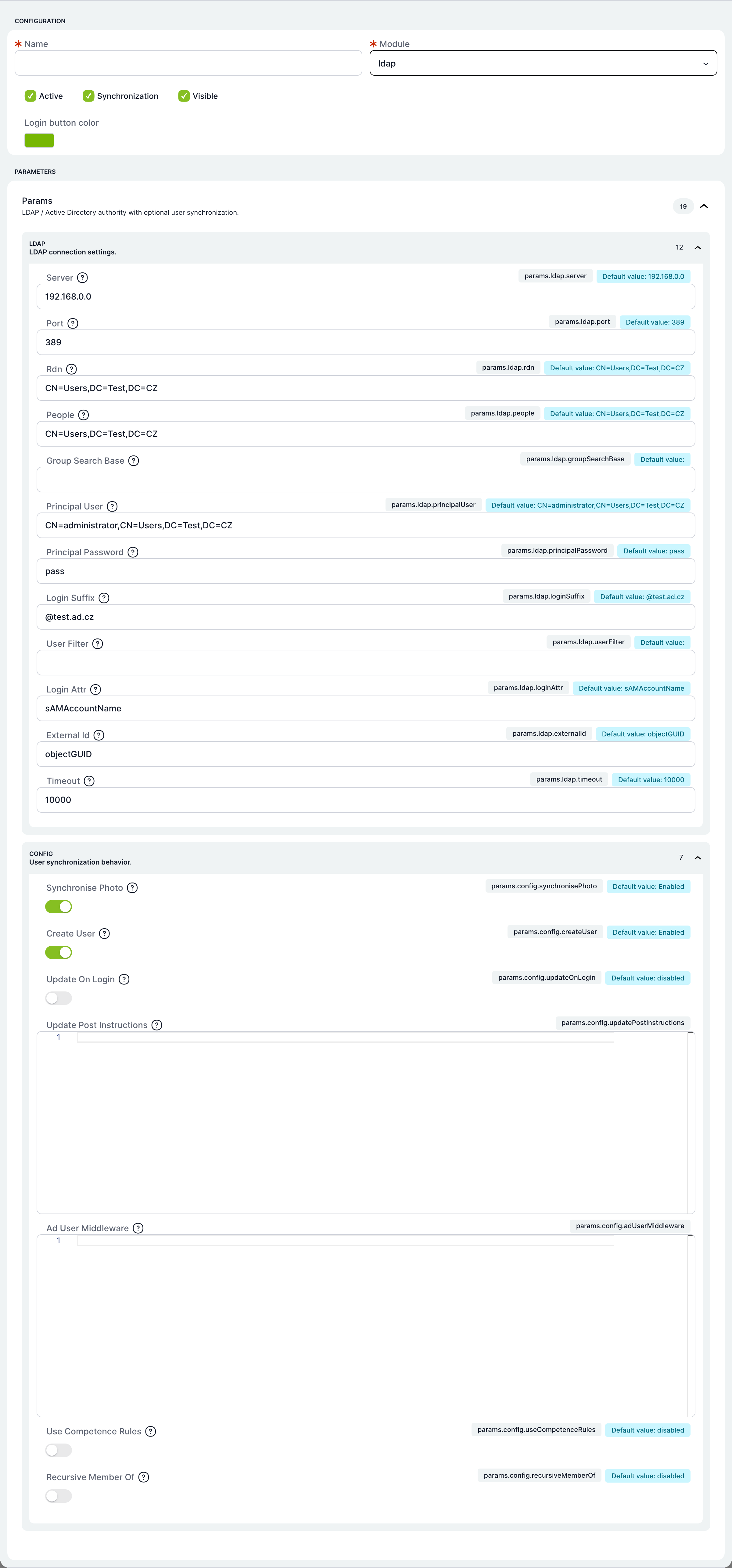
| Field | Meaning |
|---|---|
| Server | LDAP server address, e.g. 192.168.0.10. For an encrypted connection, use an address with the ldaps:// prefix. |
| Port | LDAP server port (default 389). |
| RDN | Base distinguished name (base DN) of the directory. |
| People | Distinguished name of the branch in which users are searched for. |
| Group search base (groupSearchBase) | Base from which group membership is looked up. Leave empty if you do not use groups. |
| Login user | DN of the account TAS uses to connect to the directory (bind DN). |
| Login user password | Password of the bind account. Use an account with read-only access to the directory. |
| Login suffix | Appended to the entered user name, e.g. @firma.cz. |
| User filter | Additional LDAP filter that can narrow down the set of valid users. |
| Login attribute | Directory attribute against which the entered name is compared (default sAMAccountName). |
| External ID | Attribute by which TAS recognises the same user during repeated synchronisation (default objectGUID). |
| Timeout | Connection timeout in milliseconds (default 10,000). |
| Synchronise photo | Also downloads the user's photo during synchronisation. |
| Create users | A non-existent user is created automatically on first login / synchronisation. |
| Update on login | User details are updated from the directory on every login, not only during synchronisation. |
| Script after create/update | Custom script run after a user is created or updated. |
| Record middleware | Script that can modify the raw directory record before it is mapped to a TAS user. |
| Use competence rules | Group membership (memberOf) can be used in competence rules for assigning roles – see the Roles and Competences article. |
| Recursive membership | When evaluating groups, also takes nested groups into account, not just direct membership. |
The LDAP module has no separate fields for mapping the e-mail or display name – this is handled in the Record middleware script or the Script after create/update.
Microsoft Entra ID (Azure AD)
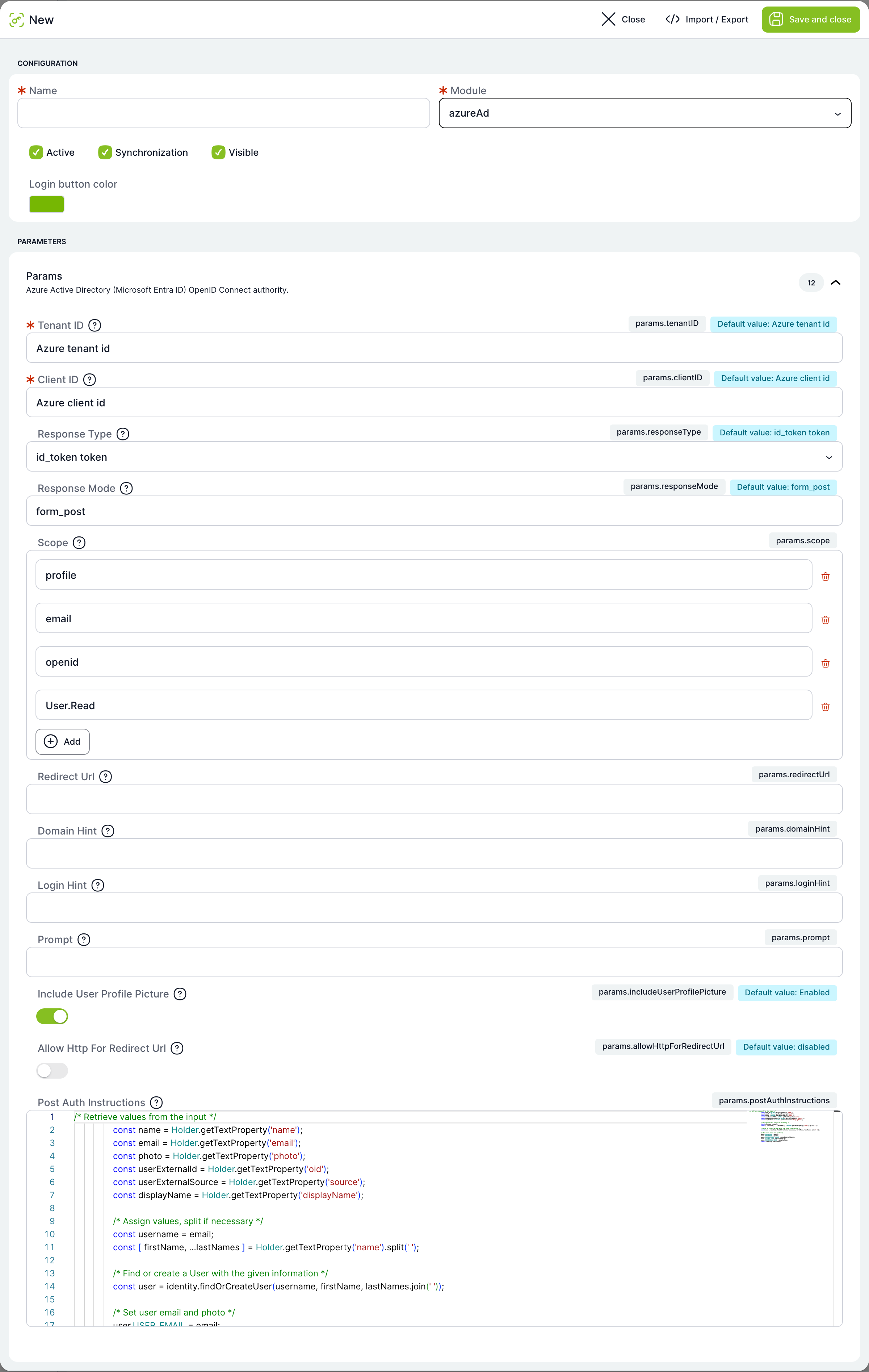
| Field | Meaning |
|---|---|
| Tenant ID | Entra ID tenant ID. |
| Client ID | ID of the application registered in Entra ID. |
| Response type | id_token or id_token token (default). The second option is required if TAS should also download the user's profile photo. |
| Response mode | Only form_post is supported. |
| Scope | List of requested permissions, default profile, email, openid, User.Read. |
| Redirect URL | Custom redirect address; if left empty, the default /auth/azure-ad/callback/<id modulu> is used. |
| Domain hint / login hint / prompt | Optional parameters passed directly to the Entra ID sign-in page (e.g. pre-filling the domain). |
| Download profile photo | Requires Response type id_token token and the User.Read scope. |
| Allow http for redirect URL | Allows unencrypted http:// as the redirect address (for testing only). |
| Script after login | Script that finds or creates a TAS user from the token claims. |
The Entra ID module signs in via the browser (OIDC implicit flow), so it has no field for a Client secret or certificate – TAS does not use them for this module type.
SAML 2.0
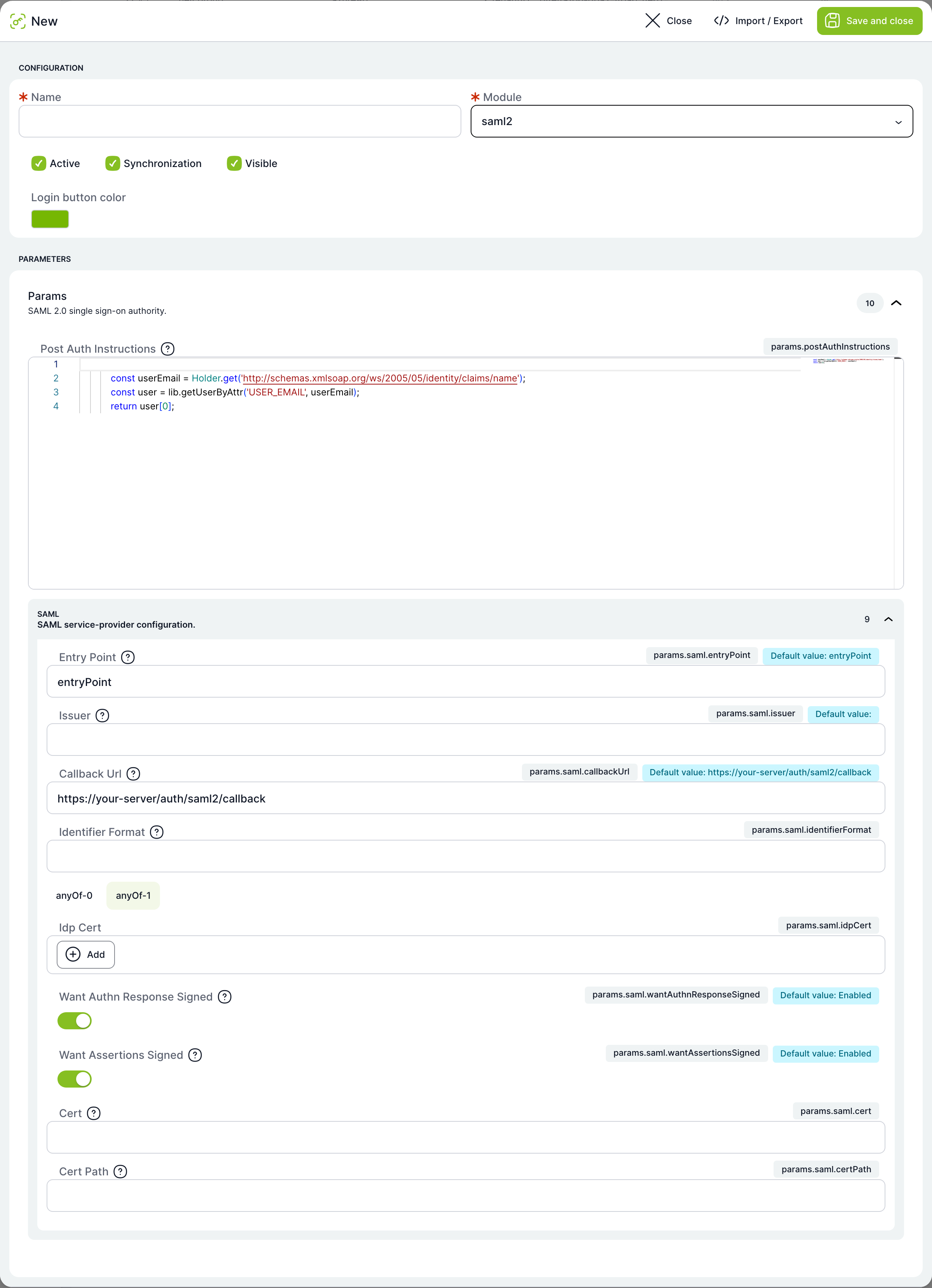
| Field | Meaning |
|---|---|
| Entry point (entryPoint) | Sign-in URL of the identity provider (IdP). |
| Issuer | Identifier of TAS as the service provider (SP entity ID). |
| Callback URL | Address to which the IdP sends its response after sign-in (ACS URL); the actual path is always /auth/saml2/callback. |
| Identifier format | Optionally requested NameID format. |
| IdP certificate (anyOf-0 / anyOf-1) | Identity provider certificate(s) for signature verification – either a single certificate or several at once. In practice it is usually not filled in manually: TAS retrieves it itself from the metadata (Cert field) or from a file (Certificate path). |
| Cert (metadata URL or certificate) | Address of the IdP XML metadata (or the certificate itself) from which TAS loads the certificate. |
| Certificate path | Alternative to the Cert field – path to the certificate file on the server. |
| Require signed response | Rejects an IdP response without a valid signature. |
| Require signed assertions | Rejects individual assertions without a valid signature. |
| Script after login | Script that finds or creates a TAS user from the SAML profile. |
NFC
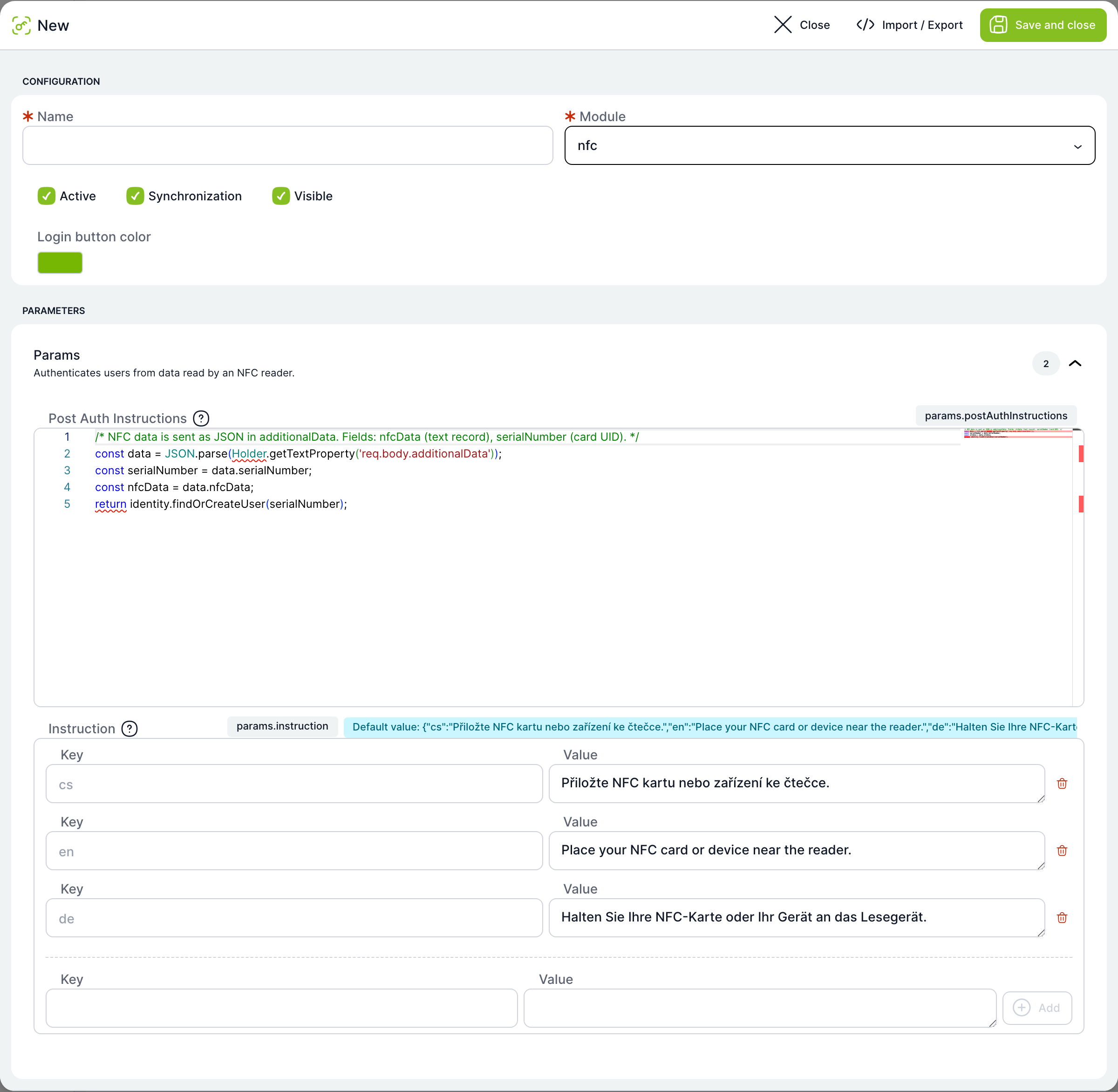
| Field | Meaning |
|---|---|
| Instructions | Text (in Czech, English, German) displayed to the user at the reader. |
| Script after login | The default script reads the card serial number from the request and finds or creates the corresponding user; it can be modified so that the card maps to a different user attribute. |
The NFC module can only be added and saved when the NFC reader switch is turned on in Configuration (
featureFlag.nfcReaderEnabled, off by default). Without it, TAS refuses to save the module.Apache Kerberos and Foreign (in brief)
Apache Kerberos has only three fields: the address of the authentication endpoint (default <adresa serveru>/kerberos), the login suffix removed from the remote user header, and the script after login.
Foreign (redirect to any external sign-in page) has a single field – the target URL to which login is redirected.
Password (login with a user name and password stored in TAS) has no settings.
SMTP OAuth authentication
This setting does not concern the login modules above – it determines how TAS authenticates sending mail through an SMTP server that requires an OAuth2 token instead of a password. It is set in Configuration, not on the Authentication screen:
| Key | Meaning |
|---|---|
integrations.mail.type | oauth2 enables this method (alongside basic, sendmail, msgraph). |
integrations.mail.host, .port | SMTP server address and port. |
integrations.mail.basicAuth.user | Mailbox on whose behalf e-mails are sent. |
integrations.mail.oauth2.host | Address where TAS obtains the OAuth2 token. |
integrations.mail.oauth2.clientId, .clientSecret | Application credentials for the token endpoint. |
integrations.mail.oauth2.grantType | OAuth2 grant type (typically client_credentials). |
integrations.mail.oauth2.scope | Requested permission scope. |
The Microsoft Graph integration (sending via integrations.mail.type: "msgraph", reading mailboxes) is described separately in the MS Graph (e-mail) article – it is not the same as SMTP OAuth, although both can target the same Microsoft 365 mailbox.
Related: Authentication, Roles and Competences, MS Graph (e-mail), Vault.