User guide
Quick Start Guide
Case notes
Table component
FAQ
Search
Dashboard
Deleted Documents and Access Log
Solving a task
AI Assistant
Manuals
Substitution and Vacation
Suspending, resuming, archiving and deleting a case
Case variables, history and graph
Basic Terms
Uploading Documents, Folders and Revisions
News
Favorites
Navigating the interface
Dashboard widgets
Case Detail
News/Announcements in Team assistant
Case list
Logging In and Out
Account Settings
Task List
Mobile app settings
Reports and Charts
Searching and Listing Documents
Handing Over, Taking Over and Tasks to Pull
Bulk Tasks
Printing a Case
Creating and Editing an Overview
What Is TAS
Form Fields
Tablet Interface and NFC
Overviews
Creating a New Case
Case Events
Case Permissions
Subscribing to an overview by email
Administrator Guide
Platform guide
Administration
Crons
Authentication and Synchronization
SMTP OAuth authentication
LDAP, SAML, Entra ID and NFC: Settings
Configuring authentication modules
Authentication
Vault
DMS attributes
Service Operations
Mobile App Setup for Your Environment
Scheme
XML Process Import
HR agenda and agenda handover
Logs
Archiving
Scripts
Sequences
System Status
News Management
Migrations
Configuration
Plugins
Email Queue
Service Console
AI monitoring
Shared Files
Settings
CSP Headers
CSV Files
Scheduled Tasks
Processing Queues
Maintenance
Administration Menu
Licenses
Dynamic Tables
Usage Statistics
Access Token Settings & Session Expiration
Visual Identity
Template
Prints
Tasks
Task calculations
Automatic task completion and cancellation
Email Task and Notifications
Task types
Smart Event task
Instructions, Sections and Testing a Task
General task settings and solver
Multi-instance
Planning: start, branching and due date
Dynamic conditions: builder
Variable assignment and sections
Variables
Class diagram, object state import and alias candidates
Document list
Text and Multiline text
Checkbox
Number
Variables: overview and common settings
Lists (texts, numbers, dates)
Dynamic Rows
Date
Dynamic list
Sequence
Dynamic Table
Shredding Process
Template graph
Template Tab
Template List
Importing, Exporting and Copying a Template
Template Headers
Case statuses
Roles
Connecting to a different database
Diagnosing services
Hyper-V: Isolated NAT Network with Port Forwarding
Users
Translations
NFC Integration
Events and Rules
AXIOS API
Plans
Axios with Vault
Users
Axios with SSL Certificate
User Detail
Calculations & Functions
Form condition
Other dynamic conditions
Optimization of API calls on dynamic conditions
Filtering in a dynamic sheet using dynamic conditions
Dynamic Conditions: Script
Dynamic Rows: Script
Calculations
Dynamic Tables
Printing and File Generation
Documents in Calculations — Complete Guide
Printing and File Generation in Calculations
DOCX document creation
Other Calculations
How and when calculations run
Calculations API reference: the lib library
Calculations API reference: variables and case
Global Scripts and React Scripts
Integrations
MS Graph
MS Graph - cron configuration
MS Graph v2 (from v5.7.102)
MS Graph - preparing the mailbox
MS Graph (email)
ISDOC.PDF
DocuSign
TAS call module - TAS 2 TAS (process creation via API)
DB View
DocuSign and electronic signatures
ERP and other integrations
Smart Events for Integrations
TAS Forms
TAS Forms
Activating the module on the environment
TAS Forms - secret creation guide for Docker Swarm
Advanced Features & Tips
Filtering in a dynamic sheet using a URL parameter (static)
Optimizing Overviews with a Large Number of Cases
API Documentation
Product
Technical Changelog
Business Changelog
Version Upgrade Guide
Upgrade to v5.19
Upgrade to TAS 5.19 - Key Changes and Removed Features
Upgrading TAS 5.17 to 5.19 – Technical Part (DevOps)
Upgrate to v5.17
Upgrade to TAS 5.17 - Key Changes and Removed Features
Asset Migration from FE to Backend (5.17 Upgrade) — DevOps
Upgrading to v5.7
Lodash upgrade v4.17.x (>v5.5)
Main changes and deprecated features (v5.3 > v5.7)
Highlighting variables in Read-only status (>v5.7.58)
Upgrading to 5.3
Dynamic conditions migration
PDF printing adjustment
Editing Task Description vs Task Instructions
Transpiling forEach to a for loop
Rendering HTML on Caseoverview
Differences between TAS4 and TAS5 - a complete overview
Best Practices for Upgrading from v4 to v5
Using validation functions
Technical details
Server prerequisites
Security and Data Protection
Security
TAS Operations Runbook
Technological architecture
News / Important information
Microsoft Disabling Basic Auth for SMTP
End of EWS support and transition to Microsoft Graph
Adjustment in EWS after MS Exchange update (29.04.2025)
Security notices
Getting Started
- All Categories /
- Administrator Guide
- Platform guide
- Administration /
- HR agenda and agenda handover
HR agenda and agenda handover
The HR agenda keeps work from stalling when someone is absent or leaving. Here you can set up substitutions for other users, see how many cases, tasks and variables each user is responsible for, and hand over a user's agenda to another user. The page is available to administrators and HR managers (role $HRmanager). Open it from Administration using the HR agenda tile.
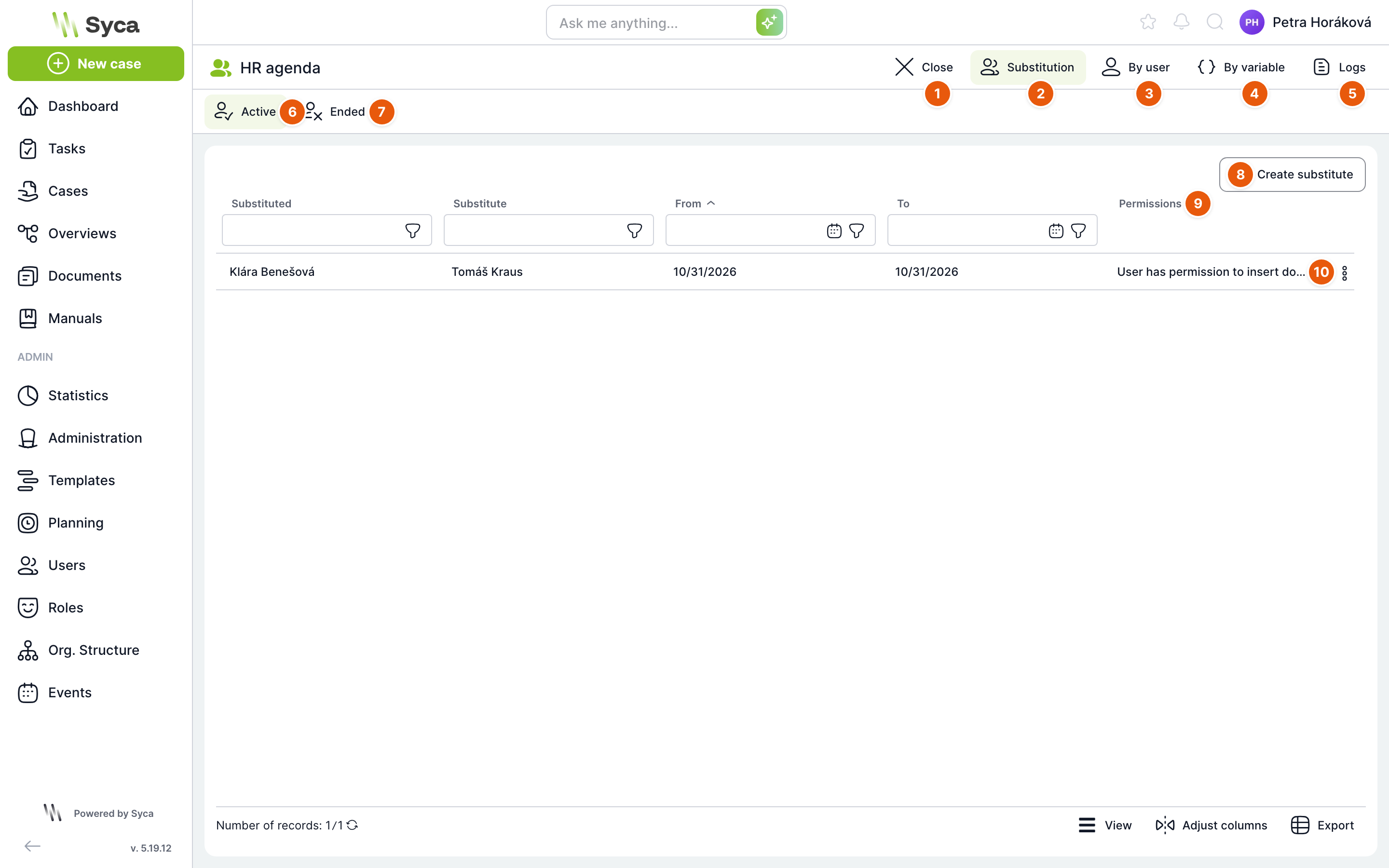
| No. | Element | Purpose |
|---|---|---|
| 1 | Close | Takes you back to Administration. |
| 2 | Substitution | Substitutions of all users. Only users with the $HRmanager role can see this tab. |
| 3 | By user | The agenda of individual users and its handover. |
| 4 | By variable | Business variables in cases where the user is specified. |
| 5 | Logs | Record of changes made in the HR agenda. |
| 6 | Active | Substitutions that have not ended yet. |
| 7 | Finished | Substitutions whose last day has already passed. Read-only. |
| 8 | Create substitution | Opens the dialog for a new substitution. |
| 9 | Permissions | The text "User has permission to insert documents and notes" if the substitute is allowed to attach documents and notes. |
| 10 | Row actions | Edit, Copy and Delete. Only on the Active tab. |
The substitutions table also has the columns Substituted user, Substitute, From and To, and is sorted by the From date. On all tabs except Substitution, there is also a Hand over complete agenda button in the top right.
Only the HR manager sets up substitutions for other users. An administrator without the $HRmanager role does not see the Substitution tab, and the HR agenda opens on the By variable tab.
Substitution
To set up a substitution for another user, click Create substitution. It works the same way as a substitution users set up for themselves, except that you also select the substituted user.
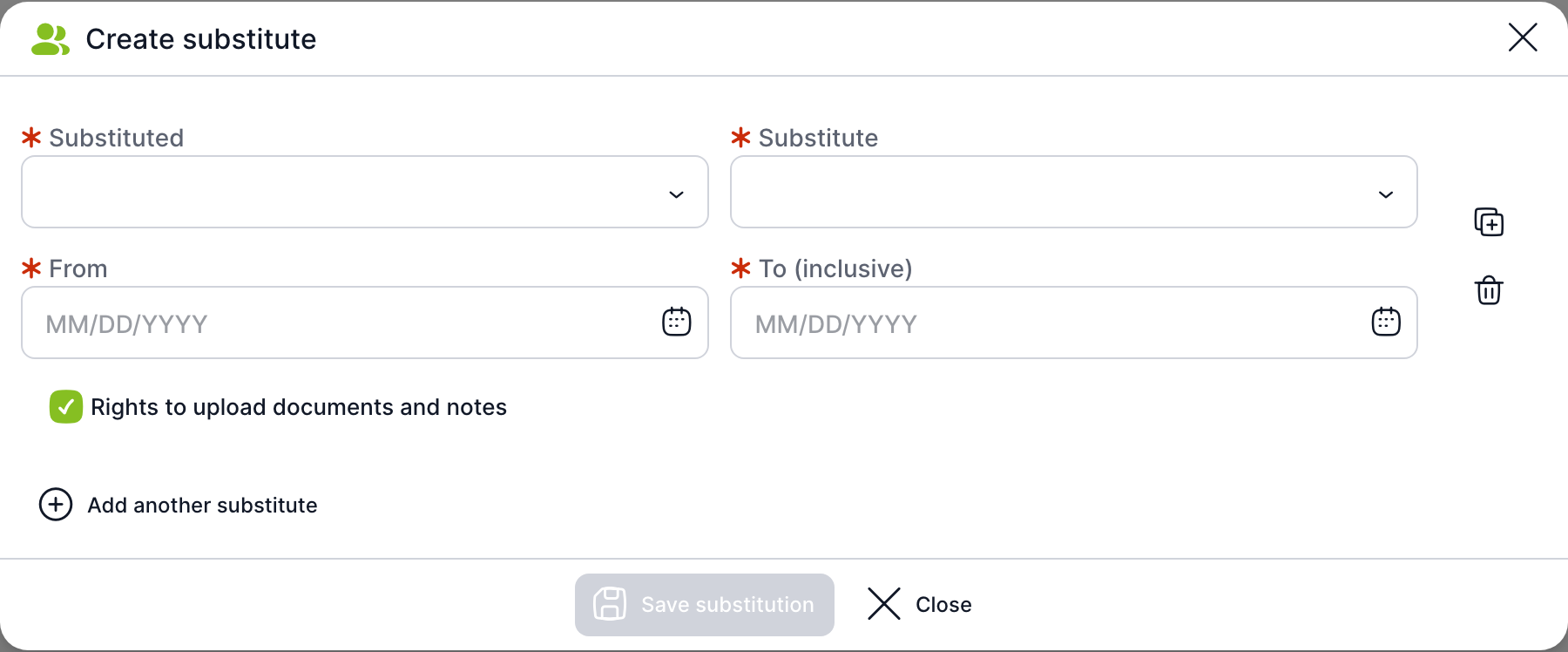
| Field | Purpose |
|---|---|
| Substituted user | Required. Who will be absent. |
| Substitute | Required. Who will stand in for them. |
| From | Required. The first day of the substitution. |
| To (inclusive) | Required. The last day of the substitution; the whole day is included. Must not be earlier than the From date. |
| Rights to insert documents and notes | The substitute may attach documents and notes to the substituted user's cases. Selected by default. |
| Copy, bin | The icons on the right copy or delete the row. |
| Add another substitution | Adds another row so you can set up several substitutions in one step. |
| Save substitution | Saves all rows. |
Substitutions for the same user must not overlap; TAS checks this both between the rows in the dialog and against substitutions already saved. After saving, both the substitute and the substituted user receive an email stating who set up the substitution.
In the row menu of an active substitution, you can Edit it (also by double-clicking), Copy it to a new dialog with prefilled details, or Delete it.
By user
An overview of users who still have some agenda assigned. Useful mainly when an employee is leaving.
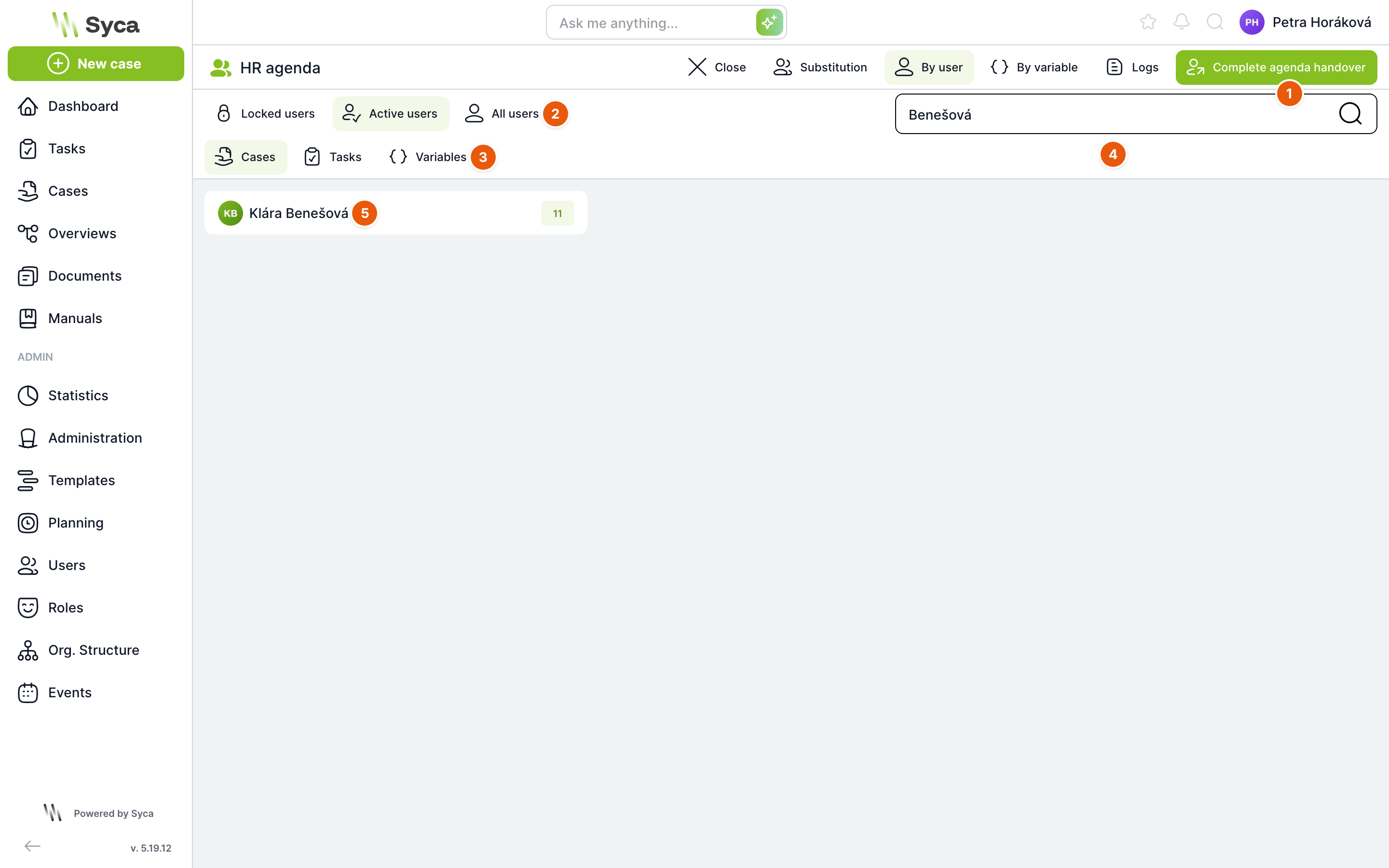
| No. | Element | Purpose |
|---|---|---|
| 1 | Hand over complete agenda | Opens the dialog for handing over one user's entire agenda to another user. |
| 2 | Locked users, Active users, All users | Which users you want to see. The default is locked users, typically those who have left and have not yet handed over their agenda. |
| 3 | Cases, Tasks, Variables | What should be counted. |
| 4 | Search | Filters users by name. |
| 5 | User card | Name and number of items. Click it to open the user's agenda. |
The number on the card means:
- Cases: cases owned by the user.
- Tasks: active, waiting and postponed tasks in running and suspended cases where the user is the solver.
- Variables: business variables of type user in active cases where the user is specified.
User agenda
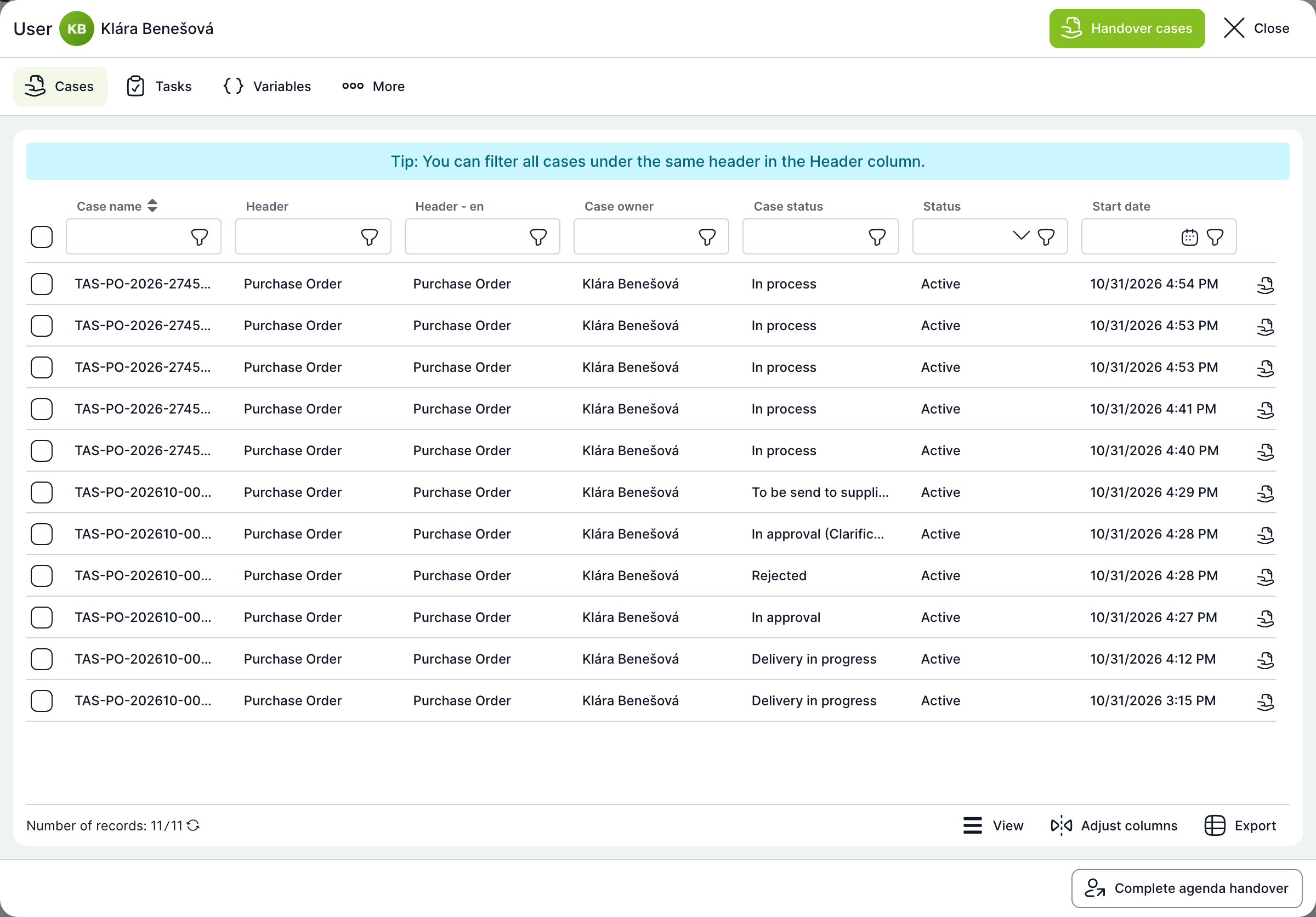
The dialog has the tabs Cases, Tasks, Variables and, under More, also Task solver and Case owner. Select the rows you want to hand over. The button in the top right changes depending on the tab: Hand over cases, Hand over tasks, Hand over variables, Change task solver or Change case owner. At the bottom is the Hand over complete agenda button for this user.
After clicking the handover button, choose whether to hand over Selected only or all rows, and select the new user in the Hand over to user field. For variables, you can select Add access to case. Without it, the new user replaces the original one in the variable but does not get access to the case.
Hand over complete agenda
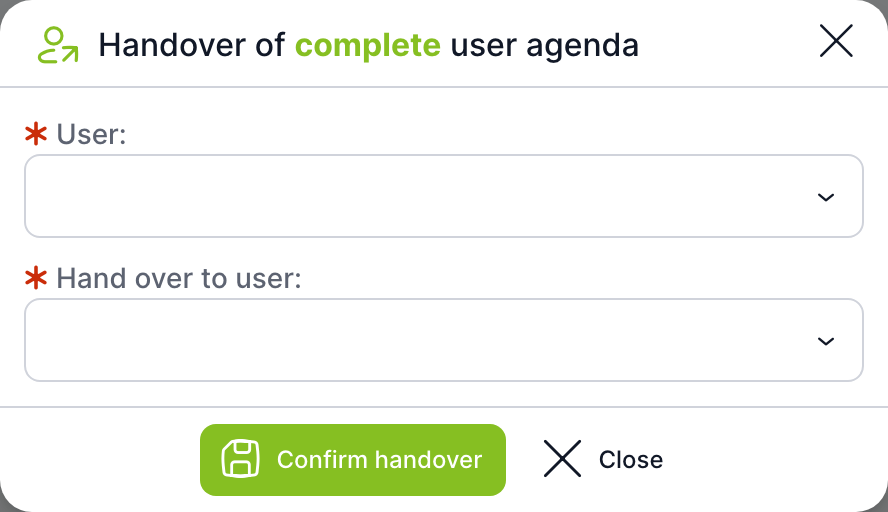
| Field | Purpose |
|---|---|
| User | Required. Whose agenda you are handing over. Prefilled when you open the dialog from the user's agenda. |
| Hand over to user | Required. Who takes over the agenda. Must be active. |
| Confirm handover | After a further confirmation "Do you really want to hand over the complete agenda…?", performs the handover. |
The handover is performed in a single step, either completely or not at all. During it, TAS:
- Transfers case ownership. The new user becomes the owner of all the original user's cases and gets rights to them, as do their managers. The original owner loses the rights derived from ownership. The case history records that the owner was changed by HR.
- Hands over tasks. All active, waiting and postponed tasks in running and suspended cases where the original user was the solver are assigned to the new user. The task is also assigned to the new user's organizational unit, and the change is recorded in the task history.
- Hands over business variables. In all active cases where the original user is specified in a business variable of type user, they are replaced by the new user. The new user and their managers get access to the case. The change is recorded in the case history.
Handing over the complete agenda does not change roles, competences, the organizational unit, management of organizational units, substitutions or template ownership. The original user remains active. If they are leaving, lock them afterwards on the Users page and hand over their roles and unit management manually.
By variable
A list of business variables of type user across cases. A business variable is a variable that the template author has marked as business-relevant, for example requester or approver.
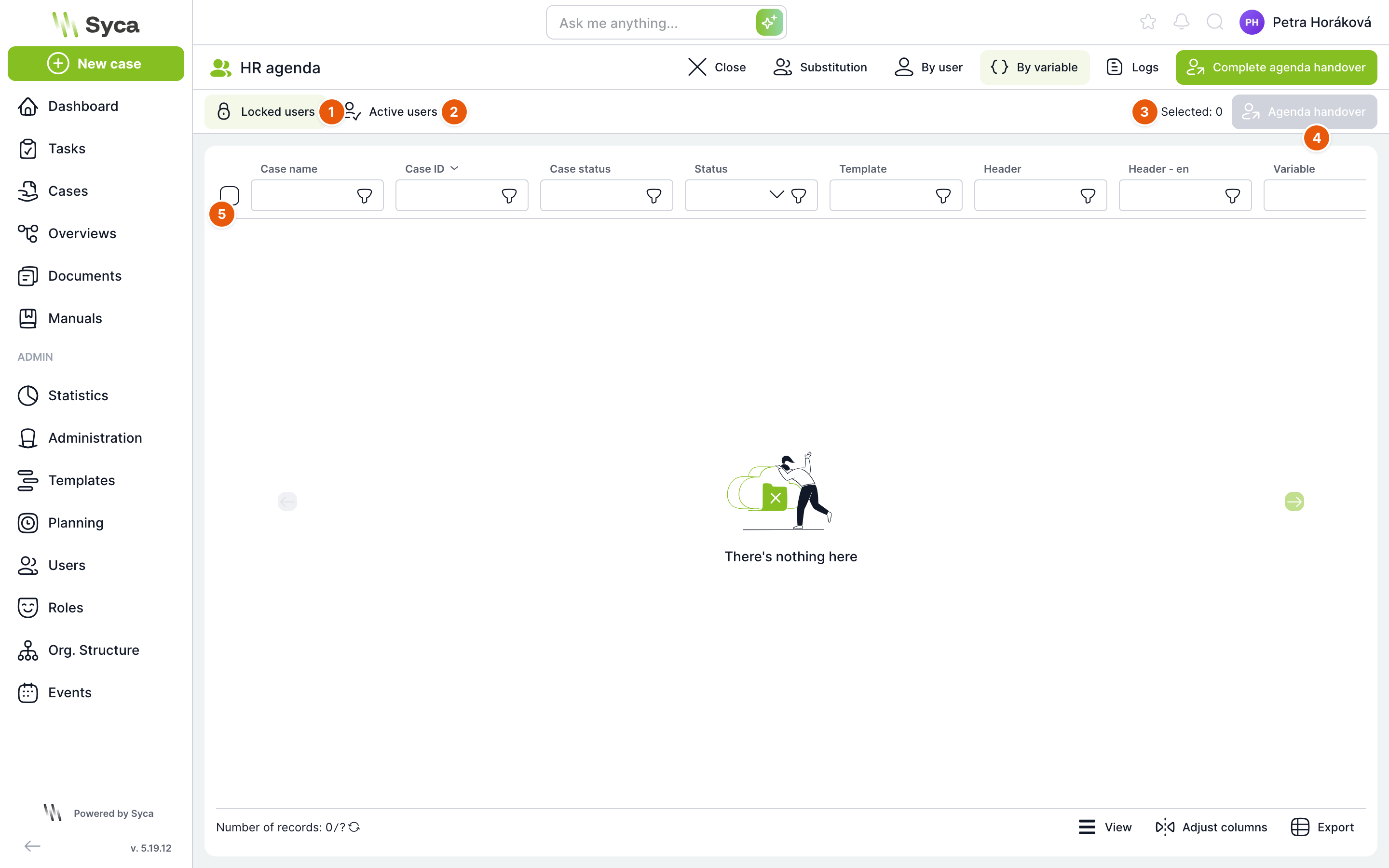
| No. | Element | Purpose |
|---|---|---|
| 1 | Locked users | Variables in which a locked user is specified, in cases in any state. |
| 2 | Active users | Business variables in active cases. The table has an additional column with the user's status. |
| 3 | Selected | Number of selected rows. |
| 4 | Agenda handover | Hands over the selected variables to another user. Enabled only when at least one row is selected. |
| 5 | Row selection | The checkbox in the header selects all rows. |
The table has the columns Case name, Case ID, Case state, Status (Active or Finished), Template, Header, Variable and Value, with the header and variable also available in language variants. Use the Case row action to open the case.
In the Agenda handover dialog, choose whether to hand over Selected only or all variables, select the New user, and optionally select Add access to case.
Logs
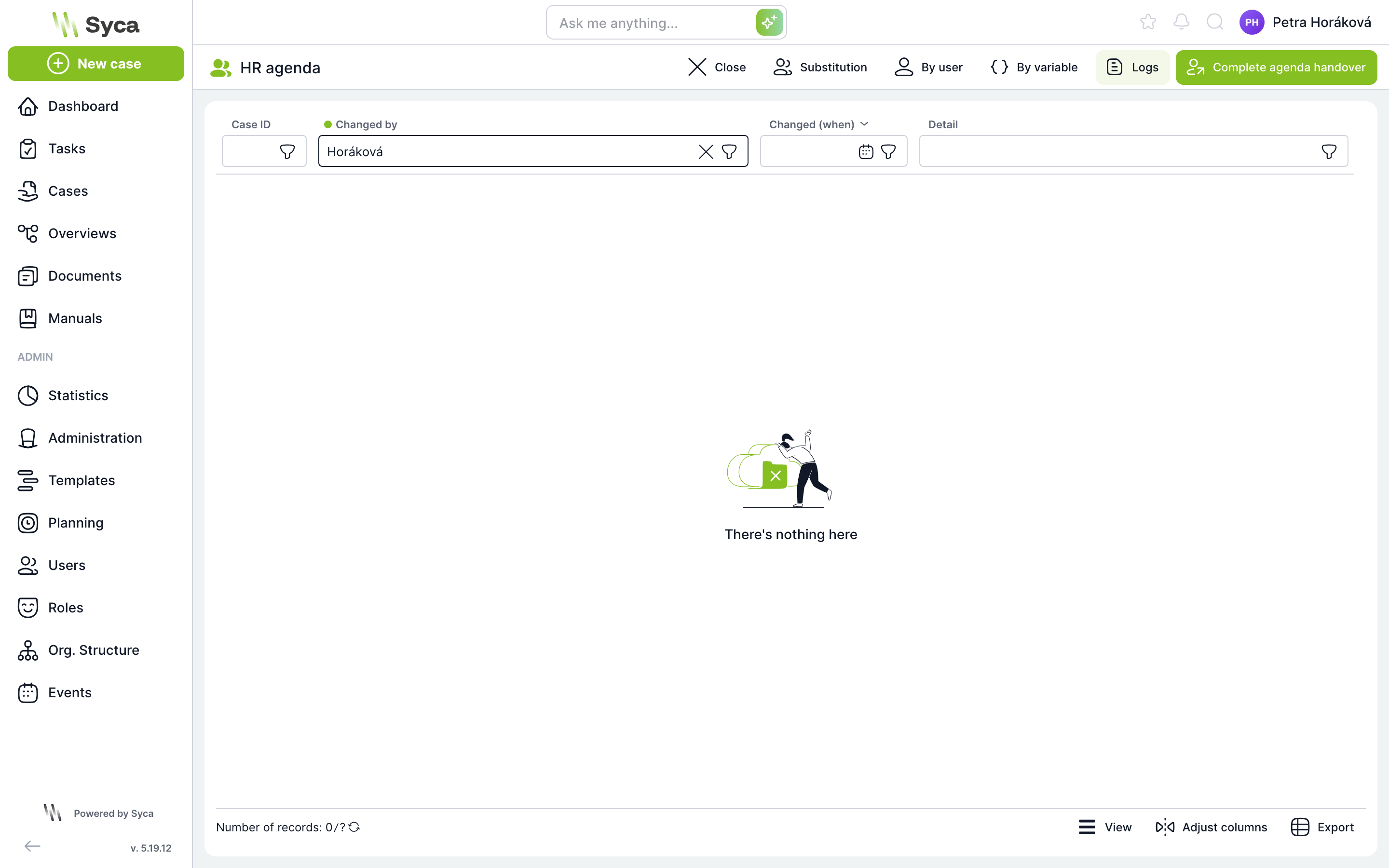
A list of changes made by HR, newest first. Columns: Case ID, Changed by, Changed (when) and Detail, which describes which variable HR changed and to whom. By default, it shows changes to business variables made in the HR agenda.
Related: Substitution and vacation, Users, Organizational structure.